
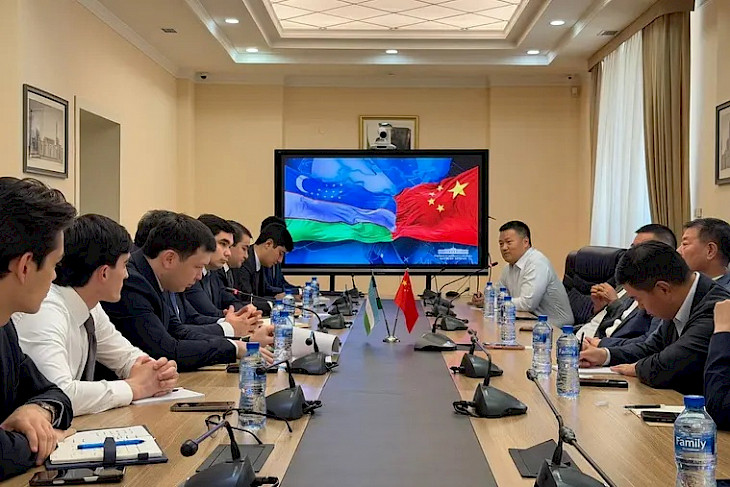
Uzbekistan and major Chinese companies intend to expand joint investment projects in the mining and chemical industries, agriculture, and food processing. This was discussed on August 12 at a meeting between Deputy Minister of Investment, Industry, and Trade of Uzbekistan Ilzat Kasimov and the heads of Sichuan Hebang Investment Group, China Feihe Limited, YEMA Group, Zhejiang ZHINK Group, and Beijing Century Beking Furniture, UzDaily.uz reported.
The Chinese companies operate in the extraction and processing of raw materials, agriculture and livestock farming, dairy and food production, PET materials, textiles, and furniture. The focus was on deposit development, advanced processing of mineral raw materials, and chemical production. The establishment of facilities for the production of powdered milk and other dairy products was also discussed. The projects will be thoroughly explored in conjunction with relevant Uzbek agencies.
Cooperation with China continues to grow rapidly. By the end of 2025, bilateral trade would reach nearly $18 billion, while Chinese direct investment in Uzbekistan had increased fivefold to $17 billion. More than 6,000 Chinese-owned enterprises operate in the country.
The key significance of these new projects lies in the transition from trade and raw material extraction to local production and advanced processing. For Uzbekistan, this represents an opportunity to create more added value domestically, strengthen its industrial base, and expand exports of finished goods.
Projects in the chemical and mineral processing sectors can stimulate the development of local suppliers and industrial cooperation. Investments in the dairy and food industries can simultaneously support agriculture, increase domestic processing capacity, and reduce imports of finished goods.
Chinese participation provides Uzbekistan not only with capital but also with technology, equipment, engineering expertise, and access to production chains. Therefore, the key indicator of success should not be the volume of declared investments, but rather the creation of enterprises with jobs, technology transfer, and export potential.
Thus, the Chinese route is becoming an important tool for Uzbekistan's industrial diversification and export growth. The most important next step is translating the agreements reached into real production projects.
CentralasianLIGHT.org
August 13, 2026