
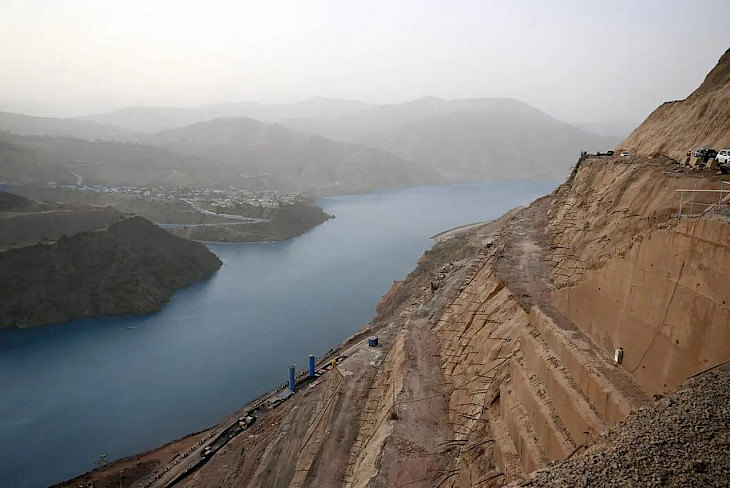
The Parliament of Tajikistan has ratified a financing agreement with the International Development Association (IDA) for the second phase of the Sustainable Financing for Rogun HPP Project, Asiaplus.tj reported.
The document provides a $300 million grant to fund ongoing construction, purchase electromechanical equipment, enhance reservoir management, implement environmental measures, and support community resettlement. Including the initial $350 million tranche, direct grant support from the World Bank for the hydroelectric power plant has reached $650 million.
The World Bank-coordinated investor consortium includes the Asian Infrastructure Investment Bank, Islamic Development Bank, Saudi Fund for Development, OPEC Fund, Kuwait Fund, Abu Dhabi Fund, and other international development partners. Upon reaching its designed 3,780 MW capacity, the station will generate roughly 14.4 billion kWh annually—supplying about 60% of Tajikistan’s electricity and boosting energy exports to Kazakhstan and Uzbekistan.
Securing a coordinated consortium of international financial institutions fundamentally alters the project's financial architecture. Previously, Dushanbe funded the mega-project primarily through the state budget—allocating 60.3 billion somoni since 2008 and an additional 11.4 billion somoni in 2026—supplemented by individual loan agreements.
However, the total estimated cost to complete Rogun stands at $6.29 billion, and funding this scale entirely through domestic resources poses significant debt sustainability risks for Tajikistan's fiscal framework.
Forming an international lender pool under the World Bank mitigates sovereign risk and secures long-term concessional financing. Completing the HPP hinges on synchronizing disbursement schedules with commercial energy off-take across the Central Asian Unified Power System. With steady inflows of concessional grants and loans, Dushanbe can install the remaining power generation units without overextending its national budget.
CentralasianLIGHT.org
October 2, 2026