
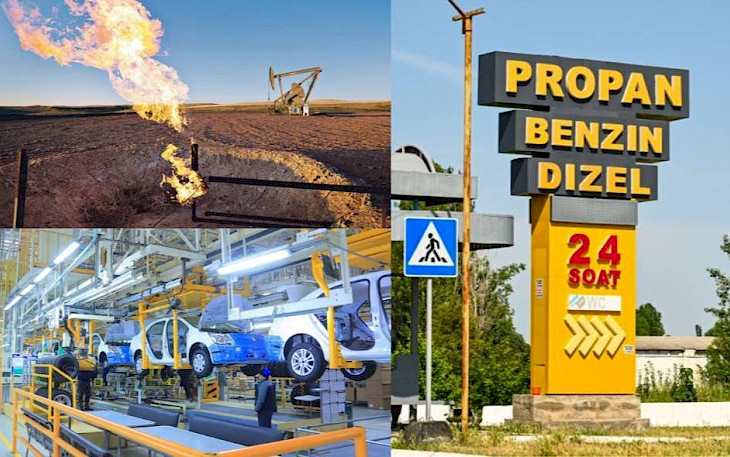
Uzbekistan has recorded a decline in natural gas, oil, and coal production amid rising industrial output and the production of automobiles, fuel, and electricity, according to the Statistics Committee of the Republic of Uzbekistan.
According to the agency, industrial production in the country amounted to 505.9 trillion soums from January to May 2026, an increase of 7.9% compared to the same period last year. Meanwhile, a significant decline was observed in the raw materials sector: natural gas production amounted to 15.8 billion cubic meters, the lowest level in nine years. For comparison, this figure reached 23 billion cubic meters in 2017 and 25.9 billion cubic meters in 2019, after which a steady downward trend began.
Decreases were also recorded in coal and oil production. Coal production fell to 1.6 million tons, 900,000 tons less than the previous year, and oil production decreased from 270,800 tons in 2025 to 261,900 tons in 2026. At the same time, the refining sector is showing growth: gasoline production increased to 502,200 tons, and diesel fuel to 476,400 tons. Passenger car production reached 190,480 units, an increase of almost 20,000 vehicles, with the Cobalt model remaining the leading model.
At the same time, the country generated 36.16 billion kWh of electricity, 3.1% more than the previous year.
The current dynamics indicate a structural shift in Uzbekistan's industry: while raw material production is declining, the role of processing industries and industrial production with higher added value is increasing. This may indicate gradual diversification of the economy, but it also raises questions about the long-term sustainability of the energy sector, given declining hydrocarbon production amid growing domestic consumption and industrial growth.
CentralasianLIGHT.org
July 6, 2026