
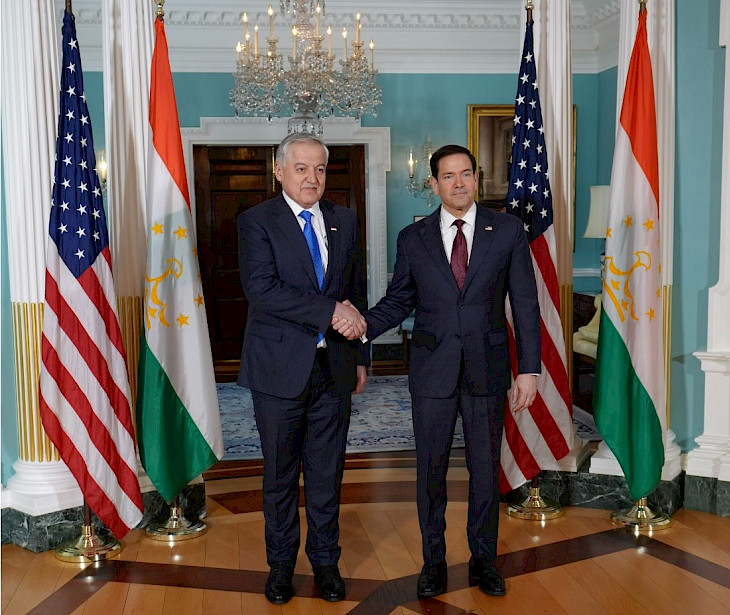
Tajikistan's Foreign Minister Sirojiddin Muhriddin and US Secretary of State Marco Rubio discussed the current state and prospects of Tajik-American relations in Washington, reaffirming their interest in further strengthening the bilateral partnership based on the principles of equality, mutual respect, and long-term cooperation.
The meeting between Sirojiddin Muhriddin and Marco Rubio demonstrates continued mutual interest in developing bilateral relations, but it is premature to speak of a qualitative breakthrough. Rather, it is a gradual strengthening of a pragmatic partnership based on the convergence of certain strategic interests.
For Washington, Tajikistan remains an important Central Asian state due to its shared border with Afghanistan, making regional security and counterterrorism issues a constant focus of the bilateral agenda. Following the withdrawal of US troops from Afghanistan, the US seeks to maintain a political presence in the region through diplomatic mechanisms, including the C5+1 format, as well as through the development of economic cooperation.
It is significant that critical minerals are at the center of the current negotiations. The US administration is actively diversifying global supply chains for strategic raw materials, seeking to reduce dependence on China. Tajikistan, which possesses significant, albeit underdeveloped, reserves of rare and non-ferrous metals, is viewed as a potential partner in this strategy. However, implementing such projects will require large-scale investment, infrastructure modernization, and an improved investment climate.
For Dushanbe, developing relations with the US is consistent with its traditional multi-vector foreign policy. Despite close allied ties with Russia, China's growing economic influence, and expanding cooperation with the Persian Gulf countries, Tajikistan's leadership is interested in diversifying its foreign policy and economic partners. Contacts with Washington allow it to attract investment, gain access to modern technologies, and strengthen the country's international position.
Thus, the current stage of Tajik-US relations is characterized by a cautious expansion of cooperation without reconsidering the existing geopolitical balance. For the US, Tajikistan remains an important element of its Central Asian strategy, while for Dushanbe, partnership with Washington is part of a course to expand foreign economic opportunities and reduce dependence on a limited number of external players.
CentralasianLIGHT.org
July 1, 2026