
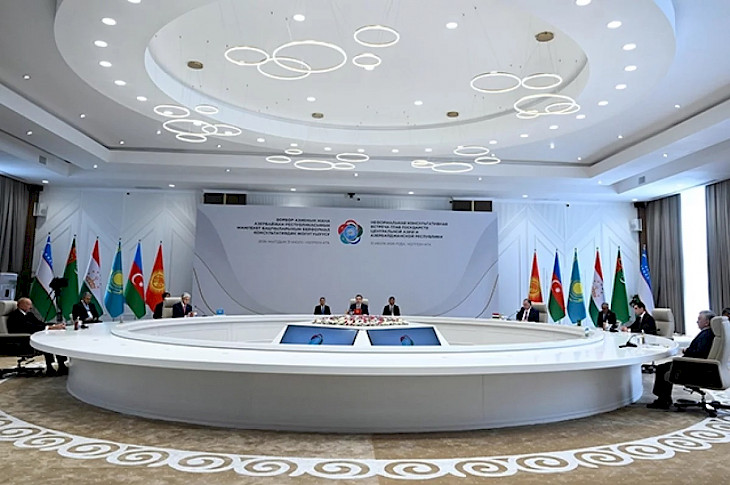
Following an informal consultative meeting in Issyk-Kul, the heads of state of Central Asia and Azerbaijan signed the Cholpon-Ata Declaration, which enshrined common approaches to the further development of regional cooperation. The meeting, held in Cholpon-Ata from July 30 to August 1, marked the next stage in strengthening political dialogue between the countries of Central Asia and Azerbaijan.
The talks were attended by the presidents of Kyrgyzstan Sadyr Japarov, Kazakhstan Kassym-Jomart Tokayev, Tajikistan Emomali Rahmon, Turkmenistan Serdar Berdimuhamedov, Uzbekistan Shavkat Mirziyoyev, and Azerbaijan Ilham Aliyev. According to Japarov, the signed declaration reflects the states' agreed positions on further deepening regional cooperation. Following the signing ceremony, the President of Kyrgyzstan declared the meeting concluded.
Trade, transport, energy, tourism, cultural and humanitarian ties, and regional security were central to the discussions. Particular attention was paid to the development of transport corridors connecting Central Asia with the South Caucasus and further to European markets. In this context, Azerbaijan's participation is particularly significant due to its geographical location and role in the development of the Trans-Caspian International Transport Route.
One of the practical proposals was Kyrgyzstan's initiative to create a unified tourist visa for foreign citizens wishing to visit Central Asian countries. Kazakhstan and Uzbekistan have already supported this idea. Japarov noted that he hopes other states in the region will join in. The initiative was first proposed by Kyrgyzstan in March 2025 and envisages the creation of a unified tourism space similar to the Schengen model.
Another important proposal was the statement by Tajik President Emomali Rahmon on the possibility of building a large oil refinery in Central Asia. He believed that energy security remains a key prerequisite for the region's sustainable development. Rahmon proposed instructing relevant agencies to study the feasibility of implementing such a project using modern technologies and taking into account the domestic needs of Central Asian countries for petroleum products.
Energy is of strategic importance to the region. Central Asia simultaneously possesses significant hydrocarbon reserves and faces shortages of certain fuels, differences in the energy mix, and the need to modernize its infrastructure. Therefore, joint projects in oil refining, electric power, gas, and renewable energy can contribute not only to increased energy sustainability but also to the development of industrial cooperation.
Azerbaijan's participation added particular significance to the meeting. Its presence expands the regional format beyond Central Asia and strengthens interactions along the Central Asia-Caspian-South Caucasus axis. Azerbaijan can serve as an important link between the countries of the region and international transport and energy markets. With growing interest in alternative trade routes, the importance of such interaction is becoming even more significant.
An important bilateral outcome was the elevation of relations between Kyrgyzstan and Azerbaijan to the level of allied relations. Azerbaijani President Ilham Aliyev also invited Sadyr Japarov to pay a state visit to Azerbaijan. This demonstrates Baku and Bishkek's desire to move beyond political dialogue and toward a more institutionalized and economically oriented cooperation.
The Cholpon-Ata meeting demonstrates a gradual shift in the nature of regional cooperation in Central Asia. While the initial consultative meetings of the presidents were primarily a platform for political dialogue and the coordination of positions, concrete economic, infrastructure, and humanitarian initiatives are now increasingly taking center stage.
The combination of three areas—transport, energy, and tourism—is particularly important. The development of transport corridors creates a physical foundation for expanding trade, energy cooperation increases the resilience of national economies, and a unified tourist visa can create additional space for population mobility and the development of services. If successfully implemented, these areas can be mutually reinforcing.
At the same time, the key challenge remains the transition from political declarations to joint projects. This will require aligning national interests, creating sustainable financing mechanisms, harmonizing border procedures, and developing cross-border infrastructure. In the case of a unified visa, harmonized entry rules, digitalized border control, and unified security standards are particularly important.
Thus, the Cholpon-Ata Declaration is significant not only as the political outcome of another summit of leaders. It reflects the emergence of a closer model of regional interaction, in which Central Asia seeks to act not as a collection of individual states, but as an interconnected economic and transport region. Azerbaijan's involvement in this process potentially expands its external ties and strengthens Central Asia's access to the Caucasus, Turkey, and European markets.
CentralasianLIGHT.org
July 31, 2026