
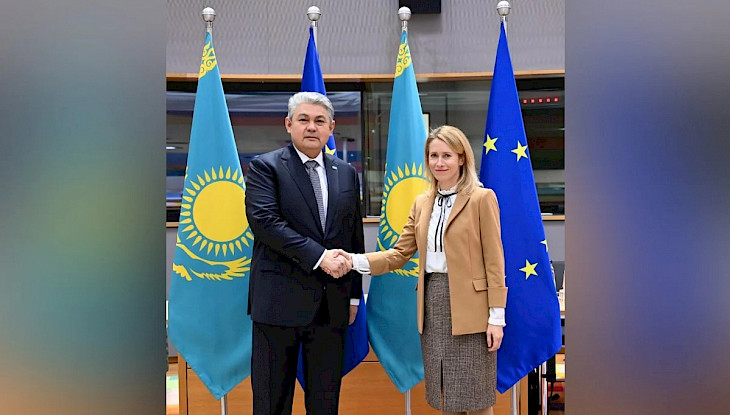
Kazakh Foreign Minister Yermek Kosherbayev held a telephone conversation with EU High Representative for Foreign Affairs and Security Policy and Vice-President of the European Commission Kaja Kallas. The parties discussed the implementation of the agreements reached following Kazakh President Kassym-Jomart Tokayev's visit to Brussels on June 23, as well as expanding trade and economic cooperation and the schedule of upcoming bilateral and multilateral contacts, Kazinform reported.
Particular attention was paid to energy and the prospects for developing the international energy supply infrastructure, including the Caspian Pipeline Consortium (CPC). The parties confirmed their interest in further strengthening their partnership.
The discussion of the CPC comes amid reports of possible disruptions to the pipeline. Previously, Kazakhstan's Ministry of Energy denied reports of a possible complete shutdown of the CPC.
The stable operation of the CPC is of strategic importance for the European Union, as this route provides one of the key channels for delivering Kazakh oil to global markets via the Black Sea. Any prolonged disruptions could impact not only Kazakhstan's export revenues but also the stability of oil supplies to Europe.
The unique feature of the CPC is that it allows Kazakhstan to export significant volumes of oil, bypassing traditional routes through Russia to European consumers. Therefore, the reliability of this corridor is in line with the EU's interests in diversifying energy routes and strengthening the resilience of supply chains.
For Kazakhstan, the CPC also remains a critical export infrastructure. Any reduction in its capacity could create additional costs, require cargo to be rerouted to alternative routes, and reduce the flexibility of Kazakhstan's oil exports.
In this situation, the EU's interest in the security of the CPC extends beyond standard energy cooperation. It is important for Brussels to maintain the resilience of the entire transport infrastructure linking Central Asia with European markets, including the development of the Trans-Caspian International Transport Route and other alternative channels.
Thus, the reliable operation of the CPC serves the interests of several parties at once: it provides Kazakhstan with stable exports, and the EU with an additional and relatively diversified source of oil. For European energy policy, maintaining the uninterrupted operation of this route is becoming especially important amid the ongoing restructuring of energy flows.
CentralasianLIGHT.org
August 13, 2026