
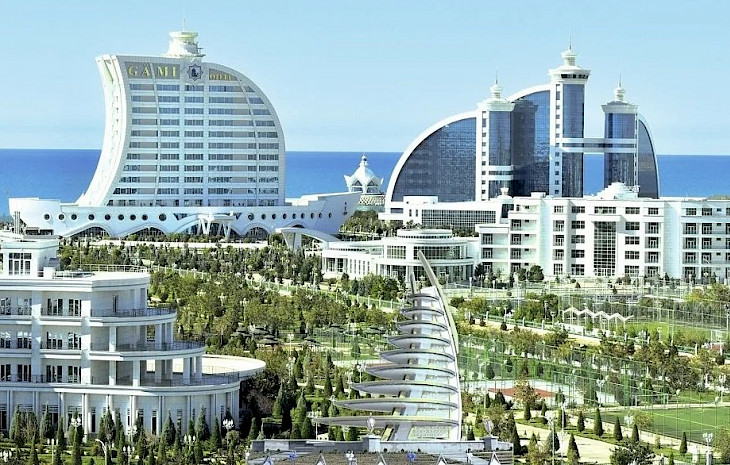
Overview: The Avaza Summit Landmark and Regional Cohesion
The week of October 4-11, 2026, represented a defining juncture in the institutional architecture of Central Asia. Anchored by the 8th Consultative Meeting of the Heads of State of Central Asia and Azerbaijan in the Avaza National Tourist Zone in Turkmenistan, the week highlighted a dramatic acceleration in economic integration, environmental governance, and diplomatic alignment across the six participating nations.
As regional dynamics shift toward multi-vector sovereignty and intra-regional self-reliance, the Avaza summits produced binding structural agreements spanning trade targets, shared water allocations, clean energy investments, and cross-border industrial chains. Concurrently, global capital recognition—highlighted by J.P. Morgan’s index watchlist placement of Kazakh sovereign debt - underscored the region’s growing status as an attractive destination for foreign direct investment.
Diplomacy and Regional Institutionalization
The 8th Consultative Meeting of Heads of State in Avaza
The primary political focal point of the week was the convening of the heads of state of Kazakhstan, Kyrgyzstan, Tajikistan, Turkmenistan, Uzbekistan, and Azerbaijan in Avaza. The summit consolidated Turkmenistan’s evolution toward an "active neutrality" doctrine, formalizing its role as a key diplomatic venue and active participant in Greater Central Asian economic initiatives.
Key outcomes of the head-of-state deliberations included:
-
Kazakhstan’s $20 billion intra-regional trade target: President Kassym-Jomart Tokayev proposed establishing an ambitious $20 billion target for intra-regional trade volume, supported by streamlined customs processes, harmonized tariff schedules, and dedicated trade houses along joint border zones.
-
Uzbekistan’s industrial supply chain initiative: Tashkent introduced a comprehensive framework for joint industrial processing and supply chain integration. The proposal focuses on co-manufacturing consumer goods, textiles, and building materials to reduce import dependency on external markets.
-
Kyrgyzstan’s unified regional marketplace platform: President Sadyr Japarov proposed creating a centralized e-commerce and digital trade platform spanning Central Asia and Azerbaijan. Designed to leverage Bishkek’s emerging IT capabilities, the platform aims to digitize cross-border business-to-business and business-to-consumer transactions and establish a unified digital clearinghouse for local producers.
-
Tajikistan’s regional oil refinery proposal: Dushanbe submitted a strategic proposal to build a state-of-the-art regional oil refinery in Tajikistan, drawing crude supplies from downstream producers to serve internal regional fuel demand and stabilize petrochemical prices.
-
Turkmenistan’s Trans-Caspian logistics and agricultural hubs: Host nation Turkmenistan proposed establishing integrated trans-shipment freight hubs along the Caspian coast and launching joint agri-industrial projects to strengthen regional food security and enhance the capacity of the Trans-Caspian International Transport Route.
Women’s Dialogue in Avaza Strengthens Humanitarian Dimension
Operating alongside the main presidential summit, the Women’s Dialogue of Central Asian States and Azerbaijan convened in Avaza to reinforce the human capital and gender equity dimensions of regional integration. The forum produced joint recommendations on expanding female entrepreneurship, protecting maternal and child health, and incorporating women leaders into climate adaptation and water management decision-making bodies.
Energy Transition and Decarbonization Strategies
Energy policy throughout the week reflected a deliberate balancing act between traditional hydrocarbon optimization and accelerated renewable deployment.
Decentralized Solar Deployment in Uzbekistan
In a major social-climate initiative, Uzbekistan announced the expansion of its $20 million "Yorqin Xonadon" (Bright Home) state program. The initiative provides fully subsidized photovoltaic rooftop solar installations to 3,100 locations, targeting 1,580 low-income households and 334 social facilities. Implemented in coordination with international energy partners, the program addresses rising domestic power tariffs while reducing peak load strains on the national grid amid declining natural gas production.
Cross-Border Hydropower and Infrastructure Financing
-
Tajikistan - Afghanistan power export expansion: Dushanbe finalized an agreement to expand seasonal electricity exports to northern Afghan provinces. The export framework ensures critical revenue streams for Tajikistan’s hydropower sector while maintaining energy access for humanitarian and residential uses across the border.
-
EBRD resumes direct financing for Turkmen private sector: Marking a notable shift in international development finance, the European Bank for Reconstruction and Development resumed direct lending mechanisms to private Turkmen enterprise. The initial funding tranche prioritizes small and medium-sized enterprises engaged in energy-efficient manufacturing and agribusiness.
-
Rosatom nuclear remediation in Tajikistan: Technical teams from Russia’s Rosatom advanced environmental rehabilitation works at Tajikistan’s historic Taboshar uranium legacy site. The remediation protects regional water tables feeding the Syr Darya basin from radiological contamination.
Water Resource Management and Climate Adaptation
Water governance remained at the top of the regional security agenda during the review period, culminating in formal binding agreements on water usage limits.
ICWC Approves 2026 - 2027 Basin Withdrawal Limits
The Interstate Commission for Water Coordination, operating within the framework of the International Fund for Saving the Aral Sea, formally approved intake limits for the Amu Darya and Syr Darya river basins for the 2026 - 2027 agricultural cycle. The structured agreement sets precise seasonal cubic-meter quotas for Kazakhstan, Kyrgyzstan, Tajikistan, Turkmenistan, and Uzbekistan.
Regional Water Convention Push
Complementing the quotas, President Tokayev advocated for a unified Central Asian Water Convention. The proposed convention seeks to institutionalize binding legal mechanisms for transboundary water management, joint investment in drip irrigation infrastructure, and mutual compensation structures for upstream seasonal reservoir regulation.
Transportation, Logistics and Infrastructure Development
Regional transport corridors experienced major developments aimed at securing Central Asia's role as Eurasia's main land bridge.
-
Turkmenistan - Iran transit expansion: Ashgabat and Tehran signed operational protocols to increase rail freight transit across their shared border crossings, specifically targeting cargo volumes moving along the North-South Transport Corridor toward Persian Gulf ports.
-
Kazakhstan - Oman investment and logistics axis: Kazakhstan deepened investment ties with Oman, focusing on maritime logistics, port management, and joint logistics hubs connecting Central Asian export routes to Middle Eastern and South Asian markets.
-
Kyrgyzstan organic export expansion: Bishkek announced that its certified organic agricultural products are now exported to over 30 countries. This milestone has been supported by new cold-chain logistics hubs established along the Naryn–Chui transport corridor.
Macroeconomic Trends and Demographic Profile
J.P. Morgan Places Kazakh Debt on Index Watchlist
In a development for Central Asian capital markets, J.P. Morgan placed Kazakhstan’s local-currency sovereign bonds on its Index Watchlist for potential inclusion in the benchmark Government Bond Index-Emerging Markets. Supported by Kazakhstan’s $2.4 billion current account surplus in H1 2026 and institutional market reforms, prospective index inclusion is projected to attract billions in foreign portfolio investment into domestic tenge debt.
China Emerges as Kyrgyzstan's Top Investor
Official economic disclosures confirmed that China solidified its status as Kyrgyzstan’s largest foreign direct investor. Capital inflows remain heavily concentrated in the Chui and Naryn regions. These investments are directly linked to critical transport infrastructure, including construction milestones along the China–Kyrgyzstan–Uzbekistan railway corridor and green energy manufacturing facilities.
Kyrgyzstan Approaches Population Ageing Threshold
Demographic data released by state statistical agencies indicates that Kyrgyzstan is rapidly approaching the international demographic threshold for population ageing (defined as 7% of the population aged 65 and older). To address this structural shift, health authorities announced the deployment of specialized clinical guidelines for geriatric care, while economic planners highlighted the urgent need to adapt national pension reserve funds and long-term healthcare infrastructure.
Conclusion and Looking Ahead
The week of October 4 - 11, 2026, demonstrated that Central Asian regionalism has transitioned from symbolic declarations to institutional coordination. The landmark decisions made during the Avaza summit—supported by binding water withdrawal agreements, decentralized renewable energy investments, and cross-border commercial platforms - reflect a region building long-term resilience.
As implementation begins on the $20 billion intra-regional trade target and new trans-Caspian freight platforms, Central Asia continues to solidify its role as an integrated economic bloc at the crossroads of Eurasia.
CentralasianLIGHT.org
October 11, 2026