
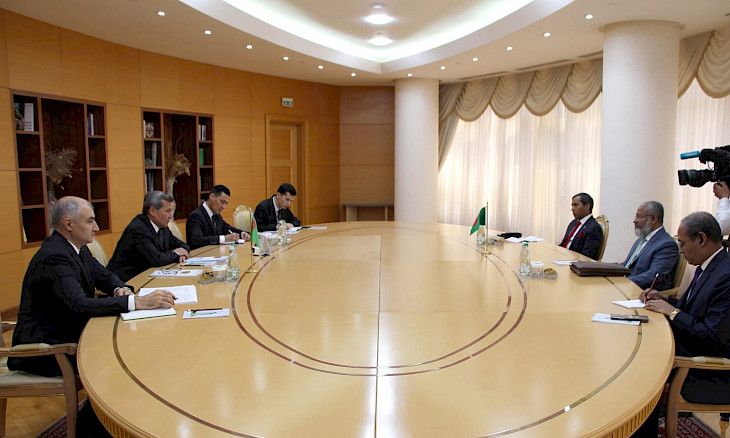
The first-ever political consultations between the foreign ministries of Turkmenistan and Bangladesh took place in Ashgabat and resulted in agreements to expand trade and economic cooperation. The parties began coordinating the "Action Program: 2027–2029," which will define the main areas of bilateral cooperation in the coming years, Orient.tm reported.
The talks were chaired by Turkmenistan's Deputy Foreign Minister Akhmet Gurbanov and Bangladesh's Secretary for Bilateral Relations, Ambassador Nazrul Islam. The Bangladeshi diplomat also met with Turkmenistan's Foreign Minister Rashid Meredov.
The textile industry was identified as one of the promising areas. Bangladesh is a major global manufacturer and exporter of ready-made garments, while Turkmenistan has significant raw materials and production capabilities in the cotton industry. This creates the preconditions for developing cooperation, from raw material production to finished goods.
The parties also expressed interest in collaborating in pharmaceuticals, petrochemicals, and energy. Turkmenistan is ready to help strengthen Bangladesh's energy security and is considering supplying mineral fertilizers for the country's agricultural sector. Dhaka, in turn, has proposed exporting jute and jute products, ceramics, light industry products, and semiconductor components to Turkmenistan.
To advance these projects, the parties are considering establishing a joint working group on trade and economic cooperation. Bangladesh has also invited Turkmen investors to explore the possibility of establishing special economic zones.
At the same time, a legal framework is being developed for agreements on mutual investment protection, the prevention of double taxation, tourism, science, and culture. The next round of political consultations will be held in Dhaka.
For Turkmenistan, rapprochement with Bangladesh is primarily of economic and geo-economic importance. Dhaka is a major market with a population of over 170 million and an important hub for the global textile industry. This partnership could allow Ashgabat to expand its exports of higher-value-added products, primarily cotton, textiles, and chemicals.
The energy aspect is equally important. Bangladesh's interest in diversifying energy sources creates a potential niche for Turkmen gas and petrochemical products. However, the practical implementation of such cooperation will depend on logistics and transport routes.
More broadly, developing relations with Bangladesh is consistent with Turkmenistan's policy of expanding ties with Asian markets and diversifying its foreign economic partners. For Ashgabat, this is also an opportunity to strengthen its position in South Asia without limiting its foreign economic ties to traditional areas.
CentralasianLIGHT.org
August 17, 2026