
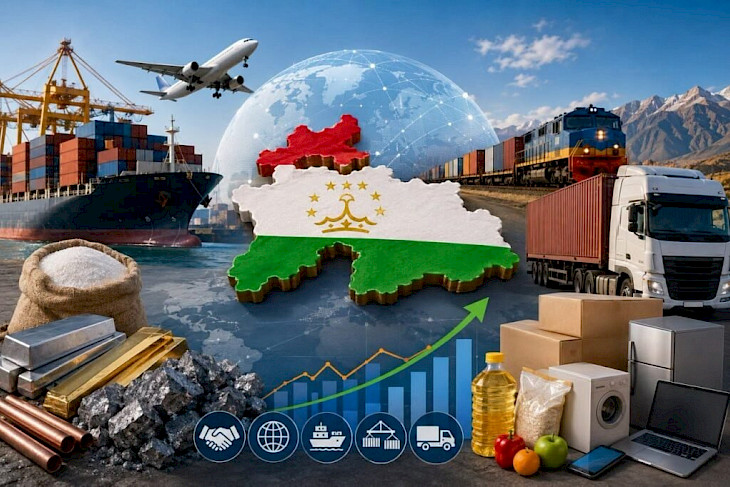
Tajikistan's foreign trade turnover for January-July 2026 amounted to $7.94 billion, an increase of 42.3%, or $2.36 billion, compared to the same period last year. This was announced by the Agency of Statistics under the President of Tajikistan, Asiaplus.tj reported today.
Despite the growth in foreign trade, the trade balance remains negative: imports exceeded exports by $4.38 billion. A year earlier, the deficit was approximately $3.31 billion, meaning it increased by approximately $1.07 billion over the year.
Moreover, exports grew faster than imports. Over the seven months, the country exported $1.78 billion worth of goods, a 57.2% increase compared to the same period last year. Imports reached $6.16 billion, an increase of 38.6%. Thus, imports are approximately 3.5 times higher than exports.
The main driver of export growth was a sharp increase in shipments of precious and semi-precious stones and metals—from $3.2 million to $519 million. Exports of mineral products increased by 47.9% to $596.7 million. Exports of textile materials and products increased by 33.7% to $159.7 million, while cotton fiber increased by 38.9% to $89.4 million.
At the same time, exports of base metals and products decreased by 27.8% to $381 million. Overall, mineral products, precious metals, and base metals accounted for approximately 84% of the country's total export revenue, indicating a high concentration of external supplies.
Machinery and equipment remained the largest import item, at $903.5 million (an increase of 38.9%). Imports of mineral products totaled $870.8 million (up 14.5%), base metals $798 million (up 64%), and vehicles and spare parts $771 million (up 29.1%). Petroleum products totaled $591 million, while wheat totaled $207.7 million.
The outpacing growth in exports is a positive sign, but it does not yet fundamentally change Tajikistan's foreign trade situation. The country still imports significantly more than it exports, and the bulk of its export revenue comes from a limited number of raw materials and semi-finished goods.
Increased imports of machinery, equipment, and transport may indicate investment activity and economic modernization. However, in the long term, it is important for Tajikistan to expand exports of higher-value-added products. Export diversification will reduce dependence on commodity prices and gradually narrow the structural trade deficit.
CentralasianLIGHT.org
August 21, 2026