
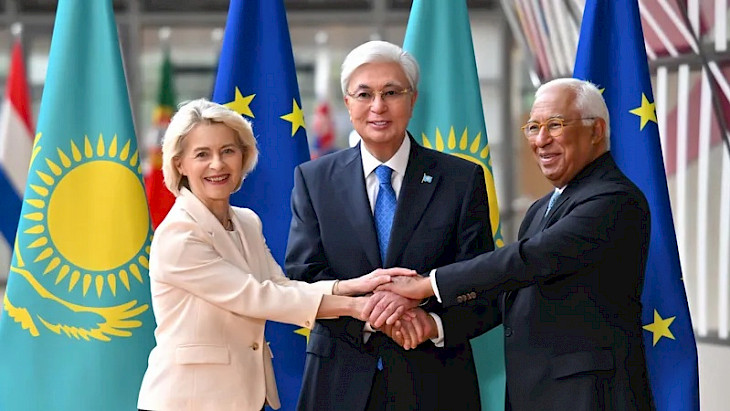
(K.A.) The results of President Kassym-Jomart Tokayev's visit to Brussels confirmed the transition of relations between Kazakhstan and the European Union to the level of an expanded strategic partnership. The signed agreements, worth over $12 billion and covering a wide range of areas—from energy and critical minerals to digitalization and education—reflect not only the growth of economic cooperation but also the consolidation of Kazakhstan's multi-vector foreign policy model.
The primary reason for this policy is Astana's desire to ensure stability in the face of global geopolitical competition. Kazakhstan, with its significant natural resources and transit location, has an objective interest in not being dependent on a single power center. Balancing between the EU, China, Russia, and other key players helps mitigate foreign policy risks and expand economic space.
The European Union plays a special role in this system as Kazakhstan's largest trade and investment partner. Nearly half of all foreign direct investment and a trade turnover of over $45 billion create a strong economic interdependence. At the same time, the EU is interested in diversifying raw material supplies, developing alternative transport routes, and accessing critical minerals, making cooperation mutually beneficial.
The Middle Corridor, which transforms Kazakhstan into a vital link between Europe and Asia, is becoming a key area of partnership. The development of this logistics axis enhances the country's strategic importance and increases its transit potential.
Thus, Kazakhstan's multi-vector policy is not a tactical choice, but a long-term strategy. It simultaneously strengthens economic resilience, attracts investment, and enhances the country's geopolitical significance by creating a balance of interests between various centers of global power.
CentralasianLIGHT.org
June 24, 2026