
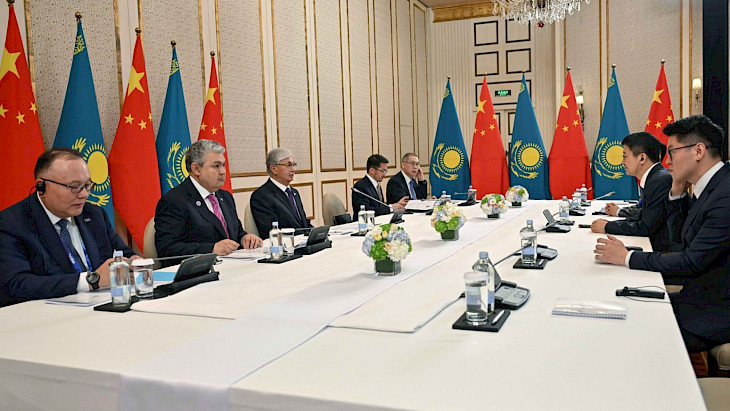
During Kazakh President Kassym-Jomart Tokayev's working visit to China on July 15-16, 2026, more than 70 commercial agreements worth over $15 billion were signed, according to the press service of the President of Kazakhstan.
The agreements cover a wide range of areas, including artificial intelligence, digital transformation, transport and logistics infrastructure, the financial sector, mechanical engineering, the automotive industry, education, and the agro-industrial complex.
Major projects include a strategic partnership with Huawei, the launch of Li Auto vehicle production, the development of electric vehicle infrastructure, the construction of a terminal at the port of Kuryk, the creation of the "Data Center Valley," and joint initiatives in robotics and artificial intelligence. The signed documents represent one of the largest packages of economic agreements between the two countries in recent years.
Analytical Commentary
The results of Kassym-Jomart Tokayev's visit to Beijing confirmed a qualitatively new stage in Kazakh-Chinese relations. While ten years ago, cooperation was primarily focused on energy, raw material extraction, and the development of transport routes, today the emphasis is noticeably shifting toward high technology, the digital economy, artificial intelligence, industrial cooperation, and joint innovation projects.
China remains one of Kazakhstan's largest trading partners and investors. Over the past decade, bilateral trade has more than doubled, and Kazakhstan has become a key participant in China's Belt and Road Initiative due to its strategic location between China and Europe. The development of the Trans-Caspian International Transport Route, the modernization of border infrastructure, and the expansion of logistics capacity are strengthening Kazakhstan's role as a key transit hub in Eurasia.
A distinctive feature of the current stage of bilateral relations is the transition from simple trade and investment to the creation of joint ventures and technological partnerships. Projects in artificial intelligence, robotics, data centers, and digital infrastructure demonstrate Kazakhstan's desire to diversify the economy and create new growth areas. For China, Kazakhstan remains a strategic partner in Central Asia, providing reliable transportation links, access to resources, and expanding its economic presence in the region. New agreements could become an important factor in modernizing Kazakhstan's economy and strengthening its competitiveness in the long term.
CentralasianLIGHT.org
July 16, 2026