
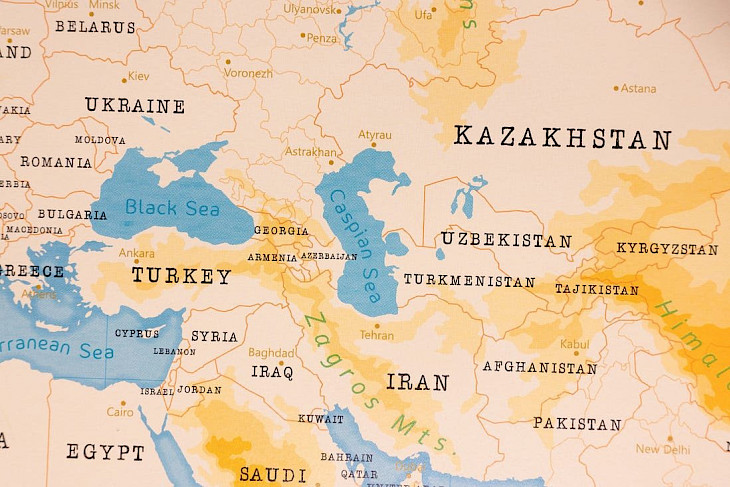
With the next meeting of the United States-sponsored C5+1 (likely soon to be expanded to C6+1) taking place in Samarkand, there has been much discussion about the origins of what has become America’s overarching strategic initiative in the broader region of Greater Central Asia. What and who gave rise to this project, which took so long to germinate but is now flourishing? And why did it arise when it did, so many years after the countries reclaimed their sovereignty?
Many have opined on these questions, with even U.S. government officials advancing histories that are not entirely accurate. It is therefore timely to review the actual process that led to Washington’s initiative back in 2015. The story begins several years before that date.
Prior to C5+1 Washington had not ignored Central Asia but it had failed to get into clear focus. Back in 2011 Secretary of State Clinton had launched her New Silk Road Strategy. However, this initiative focused less on purely regional matters than on connectivity among Central Asia, India, China, Pakistan, and Europe. Not only did the New Silk Road prove stillborn but China promptly responded with its own well-funded Belt and Road Initiative, which it announced in Astana, Kazakhstan. Washington still lacked a region-wide approach to Central Asia.
Meanwhile, other countries were moving forward. In 2001 Japan had quietly initiated its “Central Asia Plus Japan,” project, which created annual dialogues not only of heads of state but of senior officials, business leaders, practitioners, and intellectuals….all on a regional rather than bilateral level. Kazakhstan’s Minister of Foreign Affairs and later president Kassym-Jomart Tokayev hailed the group, which held its first meeting in Astana in 2004. South Korea promptly followed suit, as eventually did the European Union, and Turkey stepped up its interest as well.
Even while the new states of Central Asia carefully protected their sovereignty, collaboration was increasingly in the air regionally. All of the region’s five former Soviet republics had linked arms to get the United Nations to declare Central Asia a nuclear free zone. During the late 1990s they again linked arms to establish the Central Asia Union, which embraced not only trade and legal issues but security cooperation. When Russia’s President Putin asked to join as an observer the Central Asians consulted with major external powers including China, and the US. None considered it their business and none objected. Then Putin asked for Russia to be admitted as a full member. Again the Central Asians consulted the major powers, who again said it was up to the Central Asians. Putin had cornered them. Two years after being admitted, Russia forced Central Asians to merge their union with Putin’s Eurasian Economic Community, which would later become the Eurasian Economic Union, safely controlled by Moscow. This killed the project of Central Asian cooperation. But even as these setbacks were taking place, presidents Nursultan Nazarbayev of Kazakhstan and Islam Karimov of Uzbekistan met and agreed on close cooperation in many areas, including intelligence. While constantly torn between international and regional initiatives, Nazarbayev in this period more than once spoke of a union of Central Asian states.
Washington took little notice of these developments. A 2014 study by the Central Asia-Caucasus Institute concluded that the United States remained “the only major external actor in the region without a regularized consultative mechanism for making Central Asia/Afghanistan a living reality.”
This was the situation when Kazakhstan named Kairat Umarov its new ambassador in Washington. An experienced professional, Umarov had just served three years as Deputy Minister of Foreign Affairs. He also knew Washington, having earlier served four years at Kazakhstan’s Washington embassy.
Immediately after his arrival Umarov met with the author of this essay, director of the Central Asia-Caucasus Institute, who stressed that Washington still lacked a mechanism to interact with all Central Asia as a whole, as opposed to bilateral links. He argued that such a mechanism, if it existed, could not only promote American interests but find strong support in the region itself. He regretted that the Clinton administration had yet to launch such an initiative.
Acting decisively, Umarov in the waning days of January, 2013, consulted with Astana and then broached the matter with Nisha Biswal, the Assistant Secretary of State for South and Central Asia. Umarov carefully stressed that the creation of a consultative mechanism with all the governments of Central Asia would greatly facilitative the flow of information between the region and Washington. It would not only help balance the voices of Moscow and Beijing in regional affairs but would serve as a counterweight to the “divide and conquer” tactics of both those powers.
Biswal welcomed the proposal, declaring that “America promotes policies that make regional integration a reality, knitting together all the countries of the region through a web of energy, transit, trade and people-to-people linkages.” Because of America’s engagement with Kabul, Biswal also proposed including Afghanistan in the region, making the entity “C6+1.” She then took the proposal to Secretary of State Kerry, who approved it and called a planning meeting of the foreign ministers, to take place during the UN meetings in September, 2015. The participation of Afghanistan, however, was postponed to an unspecified time, leaving the entity “C5+1.” This happened because the Central Asians and Americans were still accustomed to thinking of “Central Asia” in narrowly Soviet terms and not as a broader region with shared relationships, cultures, and values.
Prior to the UN meeting President Nazarbayev met with President Karimov of Uzbekistan in an unexpected show of cordiality. In addition to agreeing on an exchange of business leaders, investors, and think tanks, they both endorsed the C5+1 concept. However President Karimov insisted that the planning meeting of the C5+1 foreign ministers take place in Samarkand. Both Astana and Washington assented to this and a meeting of foreign ministers was duly arranged in Uzbekistan. The first official meeting of the C5+1 did not take place until 2024, when President Biden met with his five counterparts from Central Asia on the sidelines of the annual meeting of the UN General Assembly in New York.
Beyond C5+1, Ambassador Umarov hit the ground running. Reminding Americans that at the collapse of the USSR Kazakhstan had been the world’s fourth nuclear power, he boldly declared that his country was posed to lead in everything from controlling nuclear weapons to energy security. He actively advocated for Kazakhstan to serve a term as the non-permanent member of the UN Security Council. In addition to his Central Asian project, he made pioneering trips to Houston to explore potential projects in technology and to Missouri to forge Kazakh-US agrobusiness ties.
Kairat Umarov returned to the United States to serve twice as Kazakhstan’s ambassador to the UN, where he remains today. And Nisha Biswal went on to serve as Senior Vice President of the U.S. Chamber of Commerce and now as deputy CEO of the U.S. International Development Finance Corporation. Neither has sought nor received recognition for their seminal role in creating what has now, with the pending addition of Azerbaijan, growing again to C6+1. They deserve a salute. And it is worth noting that the closest America has come to a true strategy for Greater Central Asia was initiated not by the staff of the State Department or National Security Council but by a newly appointed diplomat from the region itself, whose sovereign country had not existed two decades earlier.
Dr. S. Frederick Starr is Distinguished Fellow for Eurasia at the American Foreign Policy Council and founding chairman of the Central Asia-Caucasus Institute. His books include The Genius of Their Age: Ibn Sina, Biruni, and the Lost Enlightenment, Lost Enlightenment: Central Asia's Golden Age from the Arab Conquest to Tamerlane, and The New Silk Roads. He was also founding chairman of the Kennan Institute and has served as President of Oberlin College and the Aspen Institute.
Source: Central Asia - Caucasus Inst.
CentralasianLIGHT.org
September 29, 2026