
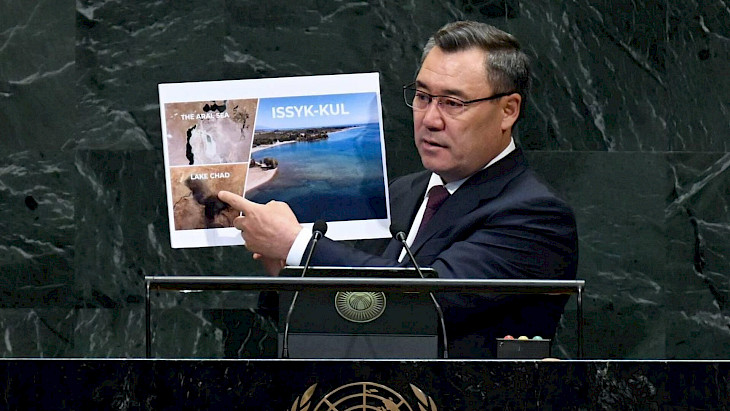
President Sadyr Japarov addressed the general debate of the 81st session of the UN General Assembly in New York on September 22 - his first since Kyrgyzstan's election as a non-permanent member of the Security Council for 2027–2028.
In his speech, he proposed implementing a mechanism to enforce UN decisions: a permanent public registry at the General Assembly with mandatory reporting by states and a four-stage procedure for responding to non-compliance, from notification and a monitoring mission to referral to the Security Council. Japarov proposed that permanent members voluntarily abstain from vetoing such matters, and that the UN Security Council be expanded to include two representatives from Africa and one from Latin America.
He also addressed the issue of sanctions for developing countries. In his opinion, the right to impose them should rest exclusively with the UN, with a mandatory assessment of the humanitarian consequences and clear criteria for lifting them. The president also thanked Donald Trump for cutting funding to NGOs worldwide, which has significantly reduced their influence in the host country's domestic affairs.
Regarding climate change, he recalled that Bishkek will host the Second Global Mountain Summit "Bishkek+25" in October 2027 and invited all interested countries to participate. Japarov called for the creation of a UN-sponsored trust fund for the conservation of Lake Issyk-Kul and is prepared to contribute $10 million from the budget. He noted that the lake's water level has dropped by almost 14 meters over 170 years, while the Tien Shan glaciers have shrunk by more than 30% over 70 years.
Kyrgyzstan received a seat on the UN Security Council for the first time in 35 years of independence, with the support of 142 states. Small countries typically spend such a term without their own agenda, but Japarov outlined a specific topic and promised to submit proposals to the relevant committee starting January 1, 2027.
The sanctions block is not an abstraction for the country: Kyrgyz banks and companies regularly face the risk of secondary restrictions. The requirement to confine sanctions authority to the Security Council transfers this vulnerability to the legal realm, where a small state has a stronger position than in bilateral negotiations.
The $10 million contribution is not so much money as an entry ticket: it changes the country's status from petitioner to co-sponsor and secures Bishkek's niche as the "voice of mountain states."
CentralasianLIGHT.org
September 23, 2026