
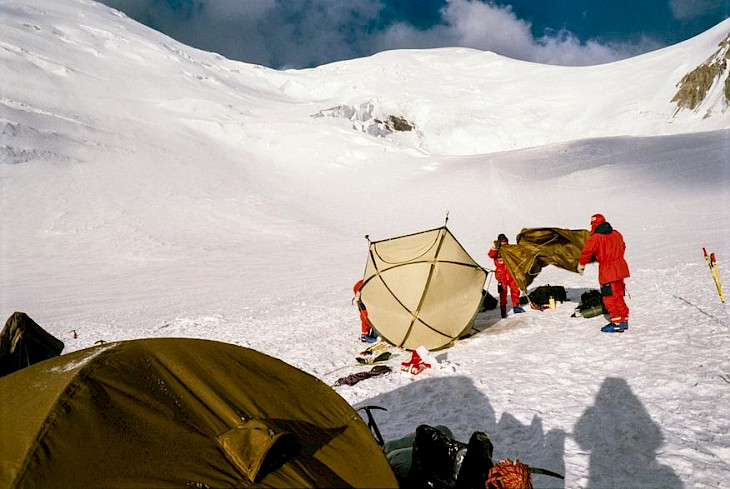
In the Pamirs of Tajikistan, scientists have discovered a glacier that is growing while others are melting—a rare natural anomaly that defies global warming, Asiaplus.tj reports.
An international team of scientists conducted an expedition to the high-altitude Kon-Chukurbashi ice cap in the Pamir Mountains of Tajikistan, where they discovered that this glacier, at an altitude of approximately 5,810 meters, was growing in size, despite the fact that most glaciers on the planet are shrinking due to climate change. This was reported by the international popular science magazine Popular Mechanics.
As part of the study, the scientists extracted two ice cores, each over 100 meters long, from the ice cap. One sample has been sent to the Ice Memory Foundation's underground repository in Antarctica for long-term climate data preservation, and the second to the Hokkaido University Institute for Low Temperature Research in Japan, where Professor Yoshinori Iizuka will analyze it to understand the glacier's unusual resilience.
Scientists hope that the data from these cores, containing up to 30,000 years of climate information, will help better explain why Kon-Chukurbashi is growing and what this may mean for the future of other glaciers around the world.
The Kon-Chukurbashi ice cap is located in the Sarykol Range of the Pamir Mountains in eastern Tajikistan, in the Gorno-Badakhshan Autonomous Region, near the border with China.
The ice cap formed on the slopes of Kon-Chukurbashi, a peak of the same name, which rises 5,811 meters above sea level.
The region is a high plateau with isolated mountain ranges, a harsh continental climate, and minimal human presence. Due to its remoteness and extreme conditions, access to the ice cap is primarily limited to scientific expeditions.
CentralasianLIGHT.org
January 12, 2026