
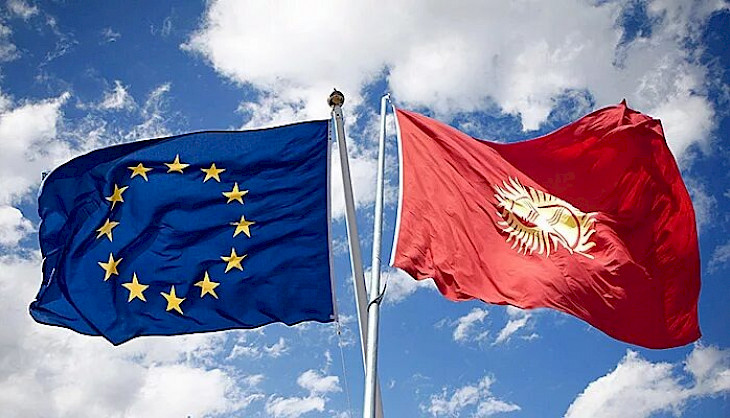
Preventing schemes to circumvent anti-Russian sanctions through Kyrgyzstan will not cause economic losses for the country nor affect legitimate business, said David O'Sullivan, the European Union's Special Envoy on Sanctions, during a visit by a European delegation to Bishkek, as reported by Economist.kg.
Responding to a question about financial risks for Kyrgyz companies in the event of tighter controls on supplies, O'Sullivan stated that the issue concerns "an extremely narrow segment of trade."
"We believe that what we are asking the Kyrgyz authorities to do — not to allow their territory to be used for sanctions evasion — will not entail economic costs for the country," the EU special representative said.
According to the European diplomat, Brussels is closely monitoring goods that are not produced in Kyrgyzstan but are imported from Europe and then re-exported to Russia with little or no processing. Such operations, O'Sullivan noted, do not generate added value within the republic and provide no systemic benefit to its economy.
The European Union has expressed concern about the potential transit through Kyrgyzstan of:
- dual-use goods;
- items from the list of priority goods that could be used for military purposes;
- certain financial transactions, including cryptocurrency operations, subject to restrictions under the 19th package of sanctions.
Brussels has previously documented cases of European goods transiting through the republic to Russia and has highlighted risks associated with certain banks and financial instruments.
Despite the tightening of sanctions enforcement, the EU emphasizes the partnership nature of its relations with Kyrgyzstan:
- bilateral trade volume reaches €3 billion;
- since 1991, the European Union has provided €600 million in financial assistance to the republic.
Brussels maintains that closing re-export channels will not affect Kyrgyzstan's fundamental economic indicators nor impact bona fide businesses.
The EU's position is that these restrictions are not directed against Kyrgyzstan as a partner, but against illicit channels used to circumvent sanctions regimes. Halting the transit of sensitive goods is a matter of upholding international obligations, not a tool of economic pressure, the European Commission insists.
In the coming days, consultations between the European delegation and key Kyrgyz government agencies — including the National Bank, the Ministry of Economy, the Ministry of Foreign Affairs, and the Presidential Administration — will continue. The outcomes of these talks may shape the parameters of future controls on supplies and financial transactions.
CentralasianLIGHT.org
February 26, 2026