
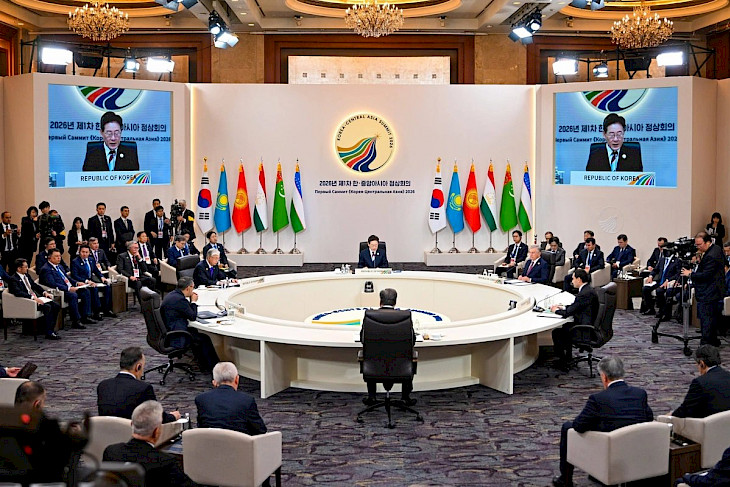
The political agenda in Central Asia during September 13–20, 2026 was dominated by an important new development in the region's international relations: the first summit between the leaders of the five Central Asian states and South Korea in Seoul. The meeting brought together the presidents of Kazakhstan, Kyrgyzstan, Tajikistan, Turkmenistan and Uzbekistan with South Korean President Lee Jae-myung and elevated nearly two decades of cooperation to the highest political level. The summit resulted in the Seoul Declaration and established a framework for regular leaders' meetings, with Kazakhstan expected to host the next summit in 2028.
The events of the week demonstrated that Central Asian foreign policy is increasingly shaped by diversification. The countries of the region continue to maintain relations with Russia and China while simultaneously expanding cooperation with South Korea, the United States, Azerbaijan, the European Union and other partners. Economic interests remain central, but political discussions are increasingly connected with critical minerals, energy security, artificial intelligence, digitalization, transport corridors and technological development.
Kazakhstan: strengthening strategic partnerships
Kazakhstan was one of the most active Central Asian participants in the Seoul diplomatic agenda. President Kassym-Jomart Tokayev held talks with South Korean President Lee Jae-myung, and the two countries agreed to deepen their relationship into a comprehensive strategic partnership. Their discussions focused on energy, critical minerals, nuclear cooperation, industrial development and supply chains.
The importance of this relationship extends beyond bilateral trade. Kazakhstan possesses substantial reserves of uranium and other strategic resources, while South Korea has advanced industrial and technological capabilities but depends heavily on imported raw materials. The two sides therefore have complementary interests.
The political significance of the agreement is also connected with Kazakhstan's broader strategy of maintaining multiple external partnerships. Astana is seeking to strengthen cooperation with technologically advanced countries without abandoning its established relations with Russia, China and other major partners. The South Korean relationship provides an additional channel for investment, technology transfer and industrial cooperation.
The broader Central Asia–South Korea summit reinforced this direction. The five Central Asian states and Seoul agreed to develop cooperation in critical minerals, energy, infrastructure, technology and investment. South Korea has expressed particular interest in moving beyond the simple purchase of raw materials toward participation in processing, manufacturing and the broader value chain.
Uzbekistan: technology, regional cooperation and the new Silk Road
Uzbekistan played a particularly visible role during the week. President Shavkat Mirziyoyev arrived in South Korea for a state visit before participating in the multilateral summit. During his bilateral meeting with President Lee, the two sides discussed transportation, logistics, healthcare, climate issues, critical minerals, artificial intelligence, digital transformation and defense-industry cooperation.
Mirziyoyev also promoted the idea of a new Silk Road based on combining Central Asia's resources and markets with South Korea's technology and industrial expertise. This approach reflects Tashkent's broader foreign-policy strategy of expanding economic and political relations beyond traditional partners.
Uzbekistan increasingly presents itself not only as a supplier of raw materials or a large consumer market, but as a potential regional production and logistics center. Cooperation with South Korea fits this objective because Korean companies have expertise in manufacturing, electronics, transport, medicine, digital technologies and advanced industrial systems.
Water and environmental issues were also included in the bilateral discussions. South Korea and Uzbekistan agreed to continue cooperation related to the Aral Sea, water shortages and climate challenges. This demonstrates how environmental problems are becoming increasingly connected with international diplomacy and development policy.
At the regional summit, Uzbekistan also proposed expanding cooperation in several strategic areas, including security, economic complementarity and humanitarian exchanges.
Kyrgyzstan: expanding political and parliamentary contacts
For Kyrgyzstan, participation in the Seoul summit provided an opportunity to strengthen bilateral relations with South Korea while also participating in a new regional diplomatic mechanism.
President Sadyr Japarov discussed bilateral cooperation with South Korean officials, including the development of political and economic ties. One specific proposal was to intensify contacts between the two countries' parliaments, including cooperation between parliamentary committees and groups. Bishkek sees interparliamentary relations as an additional instrument for strengthening political trust and implementing agreements reached by the two presidents.
Kyrgyzstan's participation in the five-country summit is also politically significant because the country has fewer economic resources than Kazakhstan or Uzbekistan. A multilateral framework with South Korea gives Bishkek an additional platform for attracting investment, technology and expertise.
The Seoul Declaration created a common political framework for future cooperation between South Korea and all five Central Asian states. For Kyrgyzstan, the challenge will be translating the diplomatic momentum into concrete projects in areas such as energy, transport, digital technologies, education and industrial development.
The country is therefore continuing to pursue a foreign policy based on maintaining relationships with several major centers of power rather than relying on a single external partner.
Tajikistan: balancing security and development diplomacy
Tajikistan's political agenda during the week combined regional diplomacy with continued engagement with the United States and other international partners.
President Emomali Rahmon participated in the first Central Asia–South Korea summit alongside the other four Central Asian leaders. The meeting placed Tajikistan within a new multilateral framework focused on economic development, technology, energy and regional cooperation. The country's geographical position gives it particular importance in discussions of regional security and connectivity.
Tajikistan's proximity to Afghanistan continues to make security an important element of its international relations. At the same time, Dushanbe is increasingly seeking to broaden external cooperation toward infrastructure, investment, energy and technological development.
The South Korean connection offers opportunities in precisely these areas. Tajikistan has considerable hydropower potential, while South Korea possesses technological and industrial capabilities that could support infrastructure and modernization projects.
The broader political challenge for Dushanbe is to convert international interest into sustainable investment while maintaining stable relations with its major external partners. Its participation in the Seoul summit demonstrates that Tajikistan is becoming increasingly integrated into the region's expanding network of diplomatic and economic partnerships.
Turkmenistan: controlled opening and economic diplomacy
Turkmenistan continued its cautious expansion of international economic diplomacy during the week. President Serdar Berdimuhamedov participated in the first Central Asia–South Korea summit and held bilateral discussions with President Lee.
The agenda included energy, transport, industry, artificial intelligence, science and technology, water management and environmental cooperation.
Energy remains the central foundation of Turkmenistan's external economic relations, particularly because of its enormous natural-gas reserves. Cooperation with South Korea provides an opportunity to expand beyond traditional energy exports into industrial and technological projects.
At the same time, Turkmenistan continues to explore ways of strengthening its international economic integration. Its efforts toward closer engagement with international trade institutions, including preparations related to WTO accession, are particularly significant. Such a process would require greater attention to trade regulation, market access and institutional modernization.
Turkmenistan's approach remains different from that of Kazakhstan and Uzbekistan. Ashgabat continues to maintain a highly controlled political and economic model, but it is simultaneously looking for new opportunities to expand international economic cooperation.
A new regional diplomatic format
The most important political development of the week was not an individual bilateral agreement but the creation of a stronger multilateral framework between South Korea and Central Asia.
The Seoul Declaration emphasized the importance of deeper cooperation between South Korea and the five Central Asian states and established regular leaders' summits every two years.
This represents an institutional development in Central Asian diplomacy. The five countries have different political systems, economic structures and foreign-policy priorities, but they increasingly recognize the advantages of presenting themselves as a connected region when dealing with external partners.
For South Korea, Central Asia offers access to energy resources, uranium, critical minerals, transport routes and emerging consumer markets. For the Central Asian states, South Korea offers advanced technology, investment, industrial expertise and opportunities to diversify their external economic relations.
The summit also illustrates the changing meaning of strategic resources. Critical minerals are no longer simply a question of mining. Their importance extends to processing, manufacturing, supply chains, technology and industrial security. South Korea's interest in developing cooperation across the entire value chain reflects this transformation.
Regional political direction
The events of September 13–20 demonstrate that Central Asia is continuing to pursue a multi-vector foreign policy. No single external power dominates the week's agenda. Instead, the five states are simultaneously developing relationships with different partners according to their individual interests.
Kazakhstan is emphasizing strategic resources, technology and industrial cooperation. Uzbekistan is promoting regional production networks and a broader economic role. Kyrgyzstan is seeking additional political and investment channels. Tajikistan is combining security diplomacy with development priorities. Turkmenistan is cautiously expanding economic engagement while maintaining its distinctive political model.
The common feature is diversification.
The region is also increasingly linking traditional diplomacy with new issues: artificial intelligence, digital transformation, critical minerals, renewable energy, nuclear power, water security, environmental protection and advanced manufacturing.
This suggests that Central Asia's international role is gradually changing. The region is no longer discussed only in terms of geography between Russia, China and South Asia. It is becoming an increasingly important participant in global discussions about energy security, supply chains, technology and connectivity.
The Seoul summit therefore represents more than a new diplomatic meeting. It is another indication that Central Asia is becoming an increasingly active and interconnected participant in the international system, while each of its five states continues to preserve its own national priorities and diplomatic identity.
Photo: Uzbek President Press Service
CentralasianLIGHT.org
September 20, 2026